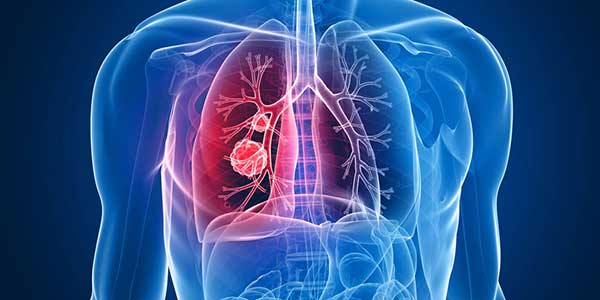
Lung cancer begins in the lungs and may spread to lymph nodes or other organs in the body, such as the brain. Cancer from other organs also may spread to the lungs. When cancer cells spread from one organ to another, they are called metastases.
Lung cancer typically doesn't cause signs and symptoms in its earliest stages. Signs and symptoms of lung cancer typically occur when the disease is advanced.Signs and symptoms of lung cancer may include:
- changes to a person’s voice, such as hoarseness
- frequent chest infections, such as bronchitis or pneumonia
- swelling in the lymph nodes in the middle of the chest
- a lingering cough that may start to get worse
- chest pain
- shortness of breath and wheezing
There are two main forms of primary lung cancer. These are classified by the type of cells in which the cancer starts growing. They are:
- non-small-cell lung cancer – the most common form, accounting for more than 87% of cases. It can be one of three types: squamous cell carcinoma, adenocarcinoma or large-cell carcinoma.
- small-cell lung cancer – a less common form that usually spreads faster than non-small-cell lung cancer.
If there's reason to think that you may have lung cancer, your doctor can order a number of tests to look for cancerous cells and to rule out other conditions.Tests may include:
- Imaging tests: X-ray image
- A CT scan imaging
- PET/CT scan imaging
- Bronchoscopy.
- Tissue sample (biopsy) and genetic mutation tests
Lung cancer is treated in several ways, depending on the type of lung cancer and how far it has spread. People with non-small cell lung cancer can be treated with surgery, chemotherapy, radiation therapy, targeted therapy, or a combination of these treatments. People with small cell lung cancer are usually treated with radiation therapy and chemotherapy.
Surgery. An operation where doctors cut out cancer tissue. There are 3 types of lung cancer surgery:
- lobectomy – where one or more large parts of the lung (called lobes) are removed. Your doctors will suggest this operation if the cancer is just in 1 section of 1 lung.
- pneumonectomy – where the entire lung is removed. This is used when the cancer is located in the middle of the lung or has spread throughout the lung.
- wedge resection or segmentectomy – where a small piece of the lung is removed. This procedure is only suitable for a small number of patients. It is only used if your doctors think your cancer is small and limited to one area of the lung. This is usually very early-stage non-small-cell lung cancer.
Chemotherapy. Using special medicines to shrink or kill the cancer. The drugs can be pills you take or medicines given in your veins, or sometimes both.
Radiation therapy. Using high-energy rays (similar to X-rays) to kill the cancer.
Targeted therapy. Using drugs to block the growth and spread of cancer cells. The drugs can be pills you take or medicines given in your veins.
As well as surgery, radiotherapy and chemotherapy, other treatments are sometimes used to treat lung cancer, such as:
Radiofrequency ablation:Radiofrequency ablation may be used to treat non-small-cell lung cancer at an early stage.The doctor uses a CT scanner to guide a needle to the site of the tumour. The needle is pressed into the tumour and radio waves are sent through the needle. These waves generate heat, which kills the cancer cells.
Cryotherapy:Cryotherapy is done in a similar way to internal radiotherapy, but instead of using a radioactive source, a device known as a cryoprobe is placed against the tumour. The cryoprobe can generate very cold temperatures, which help to shrink the tumour.
Every examination and operation related to the disease should be performed by a properly equipped hospital with the latest medical technology and professional academic medical staff. The Turkish Health Group will definitely direct you to the hospitals with the most modern medical equipment and professional medical staff related to your disease. Contact us for more information and a free second medical reference from a professional Turkish doctors.