
The Da Vinci robot is one of the most successful surgical methods which are used today around the world in the fighting against the cancer.
The first question that comes to mind when somebody talks about robotic surgery is: "Is the operation performed by a robot?" The answer to the question: Certainly NOT. Programmed robots do not perform these operations automatically, the robot is controlled by the doctors who perform the surgery. Thus, the surgery is performed not by a robot, but by a surgeon. The patient's stomach is filled with the carbon dioxide, then 5-6 ports of 8-5 mm in size are passed inside through small holes in the patient's stomach. Surgical console is located in operating room slightly away from operating table. Sitting at the console, the surgeon sees operating area in a 3-fold magnified form, performs the operation by controlling the device by means of a camera and other tools with his hands and feet. All these control panels that are controlled by the surgeon, are used at the same time. The Da Vinci robotic surgical system has two cameras that transfer the images to each eye of the surgeon separately. Thus, the surgeon, moving the robot arms that are able to move like a surgeon's hands, accompanied by these 3D images, performs complex and delicate operation in areas that are several times smaller than human hands. The percentage of the mistakes related to the fact that human hands can shake when intervening in the risk areas is significantly reduced.
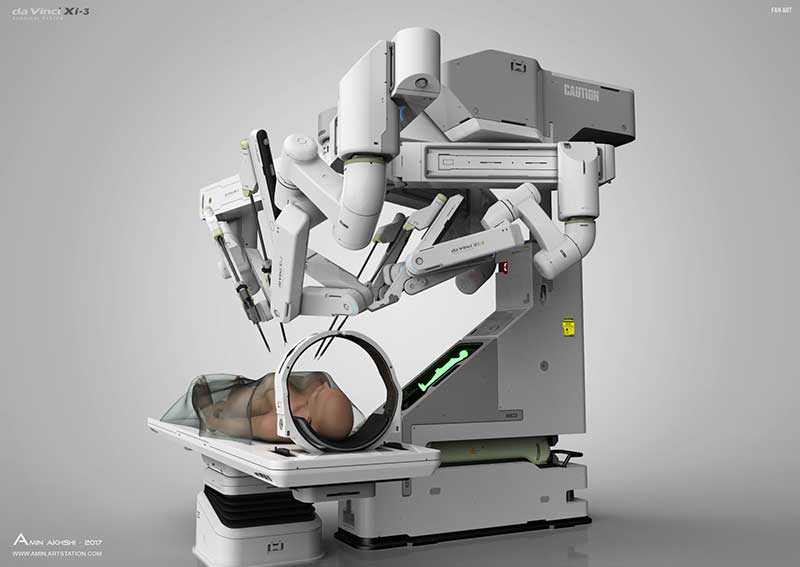
Advantages of the Da Vinci robotic surgery:
Thanks to the ability of the levers to rotate by 540 degrees and move in 6 directions, successful results are achieved in complex laparoscopic operations.
- Thanks to 3D high-quality image, the bleeding area becomes more clearly visible, thus the risk of the bleeding is reduced. In such a case, the patients do not need blood transfusions due to very small blood loss.
- The patient feels less pain
- There are no signs of the operation on the skin
- The period of stay of operated person in the hospital is shortened
- Operated patient will soon continue his/ her working and social life
- Anybody is able to start chemotherapy immediately after the operation
The fields of the application of the Da Vinci robotic surgical system;
Urology: Operations in prostate, kidney and urinary bladder cancer, narrowing of renal channels and formation of new urinal bladder
Gynaecology: uterine and vaginal cancer, uterine prolapse, endometriosis or removal of myoma, tube blockage or stenosis opening, spike, etc.
Cardiovascular surgery: By-pass, heart hole closure, mitral valve replacement and repair, tricuspid valve replacement and repair
Otorhinolaryngology: benign and malign adenoid tumours, malign and benign tongue root tumours, malign and benign nose, gums, cheeks, pharynx tumours, malign and benign larynx tumours
Colorectal Surgery: Robotic surgical system is used in surgical treatment of many colorectal diseases, including bowel cancers, diverticulosis, and inflammatory bowel diseases.
Bariatric Surgery: 3D, high-quality Da Vinci camera system and Da Vinci robotic system with ergonomic hand- operated levers is successfully used in bariatric operations.
Thyroid diseases: The presence of traces of scarring during operations of the thyroid gland located on both sides of the trachea, aesthetically bothers many patients. By means of the Da Vinci robotic surgical system, many operations of the thyroid gland are performed by intervention from the area under the armpits. In the patients operated by the Da Vinci robotic surgical system, there are no traces of the operation on the neck, except for completely hidden scar in the armpits.