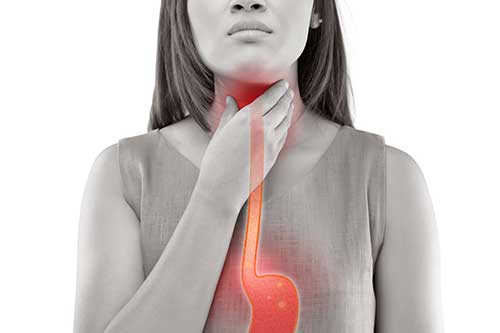
Achalasia results from progressive degeneration of ganglion cells in the myenteric plexus in the esophageal wall leading to failure of relaxation of the lower esophageal sphincter (LES) accompanied by a loss of peristalsis in the distal esophagus.This leads to difficulty swallowing and an inability to comfortably eat and drink. Patients with achalasia also commonly experience regurgitation, difficulty belching, substernal chest pain, heartburn, and weight loss. Nearly 3,000 people in the United States are affected annually.
The standard operation for achalasia treatment (laparoscopic Heller myotomy) requires multiple incisions through a patient’s abdominal wall. A new procedure —
POEM (Perpral Endoscopic Myotomy) — allows creation of the myotomy without any abdominal incisions.
Esophageal manometry is the gold standard diagnostic test. The classic findings are:
Aperistalsis of the esophagus, and
Failure of the LES to relax
An EGD is also obtained to rule out pseudoachalasia, which can occur if a malignant lesion in the distal esophagus causes distal esophageal narrowing and proximal esophageal dilation (which may look similar to achalasia on an esophagram).
POEM represents a new paradigm for achalasia treatment. It combines the minimally invasive benefit of endoscopy with the durability of a surgical myotomy. First performed in 2008, POEM uses a flexible upper endoscope to create a small incision into the mucosa of the esophagus. The endoscope is then tunneled into the esophageal wall and an endoscopic myotomy is performed (analogous to one performed during a traditional Heller myotomy). Once complete, the esophageal mucosal incision is closed using clips. POEM typically takes two to three hours to perform and requires general anesthesia.
THE ADVANTAGES OF POEM:
Minimal patient discomfort. Most patients leave the hospital on no pain medications.
Quick recovery (typically one night in the hospital)
No abdominal incisions
No risk of injury to other abdominal organs which can occur during traditional laparoscopic or Robotic-assisted surgery
No risk of wound infections or incisional hernias in the future
No visible scars
Every examination and operation related to the disease should be performed by a properly equipped hospital with the latest medical technology and professional academic medical staff. The Turkish Health Group will definitely direct you to the hospitals with the most modern medical equipment and professional medical staff related to your disease. Contact us for more information and a free second medical reference from a professional Turkish doctors.